
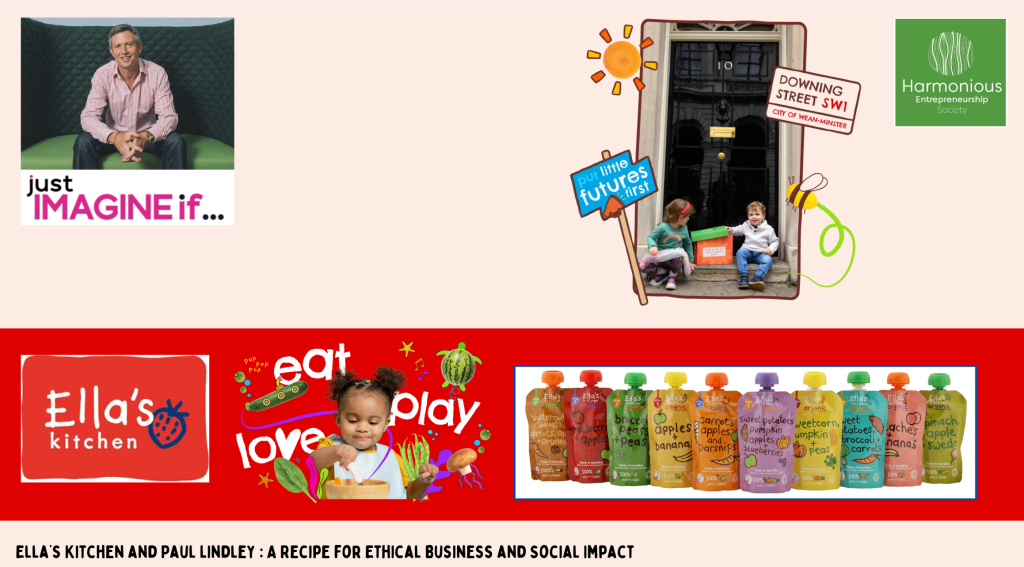
“Here at Ella’s Kitchen we try really hard to be good in sense – not just through the good food we make but also by doing good stuff for our environment and giving stuff back to our local communities” (Paul Lindley)
Ella’s Kitchen is the UK’s best selling baby food company, selling in over 40 countries. It was founded in 2006 by 40-year-old Paul Lindley, an economics graduate of Reading University, and formerly deputy managing director of Nickelodeon, the American pay to view channel aimed at children. His aim for the company, which he named after his baby daughter, was to create “an ethical, sustainable, campaigning business to provide children with the nutrition they need in a fun way”. Having experienced difficulty getting Ella to eat baby food, been dissatisfied with the varieties available in the UK, and being conscious of the growing problem of child obesity, he saw a gap in the market and set up Ella’s kitchen with his personal savings of £25, 000 and a deal with his former employer, Nickelodeon. They would provide free advertising for the company in return for a share of the profits. In 2006 Sainsbury agreed to stock the company’s products, which were manufactured for Ella’s kitchen by a food manufacturing firm in Scotland. Soon other retailers were also wanting to sell their products and in order to meet demand and grow the business Paul re-mortgaged his home.

In 2009 they started to export their organic food products, initially to Norway, Sweden and the United States and in the first 7 years of the business they doubled its turnover every year. By 2013 it had a turnover of £100 million and though the company was profitable, copycat rivals were entering the market, particularly in the USA, so in 2013 he sold the business for $103.5 million (£66 million) to Hain Celestial an American Food company. However, rather than retire, he stayed on as Chairman until 2018, by which time the company had become a certified B Corp with a score in 2016 of 81.2. As he says, what has always driven him is “the idea that business has a responsibility to be good for society” and in 2018 he resigned and set up “Just IMAGINE if…”, an annual university-hosted, business-focused, non-profit competition to address the UN’s Sustainable Development Goals”. The competition has run since 2019 and one of the things Paul claims to have learned, is that corporate social responsibility is outdated and even the terms “social enterprise” and “impact business” should not be used. As with Harmonious Entrepreneurship “social impact”, he suggests, “should be so intertwined with a business model, you cannot tell where the former ends and the latter begins”.
Meanwhile under Hain Celestial, Ella’s Kitchen has continued to exemplify such a Harmonious Entrepreneurship model. In 2021 its B Corp impact assessment score rose to 94, the company being noted particularly for its positive environmental impact and the treatment of its workforce, while on 24th October 2024, the company presented a petition to the UK Prime Minister signed by 14,000 people calling for the urgent introduction of a Future Generations Act similar to the one introduced in Wales in 2015. The Act would help to safeguard the wellbeing of the country’s children by improving “the social, cultural and environmental well-being of the UK”. As the Director of Impact for Ella’s Kitchen, Chris Jenkins, says “we are determined to drive change wherever we can. This Act has the power to deliver change for generations to come”, something HES is aiming to do also.
Ella’s Kitchen is a profit making business that addresses the global sustainability challenge. It is an example of a Harmonious Enterprise in which profit, planet and people are in harmony with each other – an example of a world of gender and racial equality, free from businesses polluting our environment and childhood obesity. “It is these dreams”, says Paul, “that led me to establish ‘Just IMAGINE if…’.”
https://www.paullindley.uk/journal/just-imagine-if-business-was-always-a-force-of-good
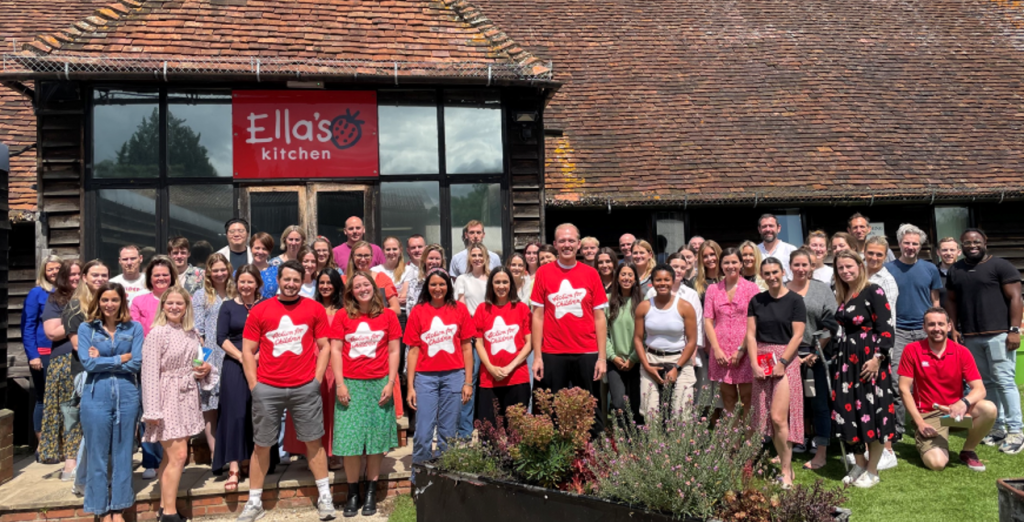
Ella’s Kitchen aligns closely with the SDGs by embedding sustainability and social impact into its core business. It addresses SDG 2 (Zero Hunger) by promoting early-life nutrition and raising awareness of balanced diets, while SDG 3 (Good Health and Well-being) is reflected in its commitment to reducing childhood obesity and advocating for improved food standards. The company fosters SDG 8 (Decent Work and Economic Growth) through ethical employment practices and a positive workplace culture, and SDG 12 (Responsible Consumption and Production) by prioritising sustainable sourcing, waste reduction, and eco-friendly packaging as a certified B Corp. Ella’s Kitchen also contributes to SDG 13 (Climate Action) by reducing its carbon footprint and championing environmentally friendly initiatives. Finally, through its advocacy and partnerships—such as its petition for a UK-wide Future Generations Act—the company supports SDG 17 (Partnerships for the Goals), demonstrating that business can be a force for good while maintaining profitability.
© Harmonious-Entrepreneurship.org / Harmonious Entrepreneurship Ltd.
 HES 2020-2026