
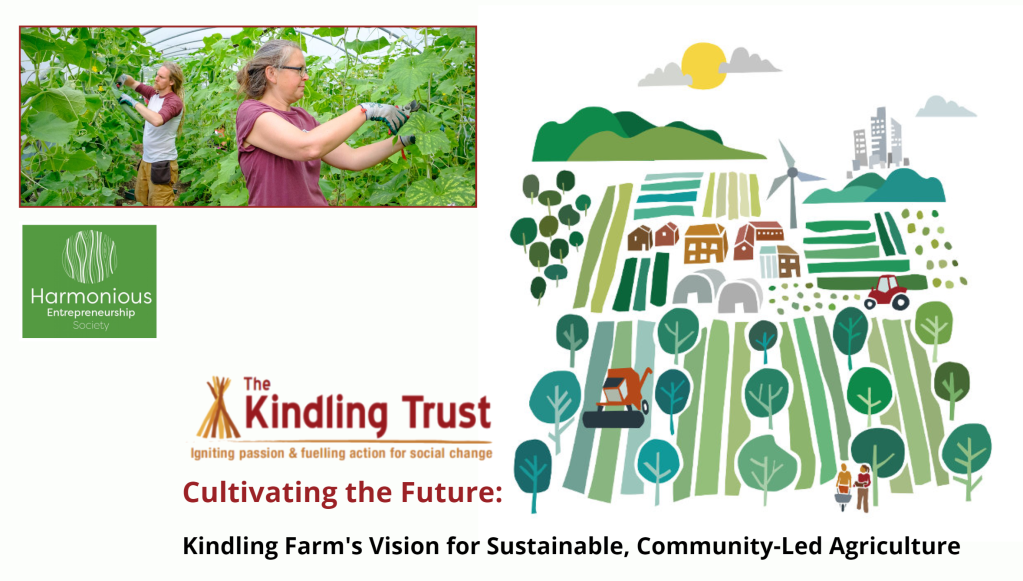
“The world needs new models of agriculture: farms that are of course productive but also sustainable for many centuries to come; that are resilient—able to adjust to climate change, that are people-friendly, offering plenty of good jobs and supporting local communities; and that treat livestock humanely; and are wildlife-friendly.” (Ruth West).
Barn Hay Farm was a traditional 77-acre family farm located between Widnes and Liverpool in the Northwest of England, with easy access to the West-East M62 motorway between the Liverpool and Manchester conurbations. The land, which is largely flat, is set around a courtyard comprising a farmhouse and outbuildings and is ideal for vegetable and arable farming, with plenty of space to plant fruit trees.

In November 2022, the farm was put up for sale, and in March 2023, it was bought by the Kindling Farm, a Community Benefit Society owned by its 800 members. Though separate from the Manchester-based, not-for-profit Kindling Trust (https://kindling.org.uk), it shares the same vision and values. The Trust works with activists, communities, farmers, and policymakers to bring about environmental and social change through food, its aim being to create a just and ecologically sustainable society, whether urban or rural.

To purchase the farm, the Trust raised £1.3 million from two community share offers in 2021 and 2023, a short-term low-interest bridging loan from the Esmee Fairbairn Foundation1 and a loan of £600,000 from the Triodos Bank2 to be repaid over 25 years from the farm’s proposed trading activities. These are outlined in a detailed 78-page 5-year business plan that shows a 6 percent net surplus from the years 2027/28. According to the plan, the farm will be community-owned and will promote sustainable farming practices that will produce healthy organic food for everyone. Once refurbished, the farm buildings will house a Centre for Social Change and a Social Enterprise hub that will offer training programmes and help to incubate promising innovative enterprises that “will add value to the crops we grow, encouraging local economic resilience and addressing economic inequality”.
To deliver this, the farm will relaunch its community share offer in the spring of 2024 (farm@kindling.org.uk) and is relying very largely on the experience gained by the Trust since its foundation in 2007, as well as the partnerships that have been formed3, including a strong partnership with the University of Manchester. However, as the Trust acknowledges, its people are its most important asset, and it is them that will make Kindling Farm a success. Whether it is the farm’s advisory group and founding members or the teams of family enterprises that are building the markets, training new growers, or engaging volunteers, it is their passion and hard work that account for the Trust’s success.

As Kindling’s co-founder and coordinator, Helen Woodcock, has observed, they “want to create a food system in the Northwest that values growers and producers, respects and restores the land, and prioritises the health and well-being-being of communities”.
While the project is very much a work in progress, according to Jess Edwards (Relationship Manager for Triodos Bank UK); “This project has the potential to make a significant social impact while protecting and prioritising nature, and we hope it offers inspiration for similar projects across the country”. It is very much an embryonic Harmonious Enterprise that is not about “making as much money as possible” at the expense of the planet and its inhabitants. Rather, profit, planet, and people are in harmony with each other, and the project addresses SDGs 11 (Sustainable Cities and Communities), 12 (Responsible Consumption and Production), 15 (Life on Land), 8 (Decent Work and Economic Growth), 9 (Industry, Innovation, and Infrastructure), 10 (Reduced Inequalities), 3 (Good Health and Well-Being), 4 (Quality Education), and 17 (Partnerships for the Goals).
Notes
1 The Esme Fairborn Foundation was established in 1961 to help restore and protect our natural world, to contribute to a socially just and anti-racist society, and to help local people develop creative, confident communities.
2. Triodos Bank is an independent bank that was founded in 1980 and has become a global leader in sustainable banking. It does not see any conflict between the pursuit of a good financial return and a concern for people and the planet.
3. In section 2 of the Kindling Farm Business Plan details are given of the various food and farming projects that the Trust has initiated and supported, the expertise that has been acquired, and the partnerships that have been formed.
Reference
James, E. (2023), Triodos Bank backs Pioneering Community Farm. Triodos Bank Press Release. 26th October.
© Harmonious-Entrepreneurship.org / Harmonious Entrepreneurship Ltd. (2020-2024).
 HES 2020-2026