
“Because we all share this planet Earth, we have to learn to live in harmony and peace with each other and with nature. This is not just a dream but a necessity” (Dalai Lama XIV)
At a time when the human race seems to be intent on destroying the planet and its inhabitants, the Catholic Church has issued the results of a 3-year consideration of the Church’s attitude towards the environment. Published on September 2nd, 2026, as “Caring for our Common Home”, the 30,000-word publication makes the connection between damage to the natural world and harm to communities, particularly the poorest and most vulnerable, as well as future generations. It regards destruction of the environment as a sin against creation and advocates more responsible consumption, healthier approaches to work and greater attention to the needs of vulnerable people. It argues that caring for the planet is inseparable from caring for people and contends that there needs to be cooperation between all faiths to address the sustainability challenge.
This is interesting as all of the major world religions would seem to share similar objectives. For example, the ancient Chinese religion of Taoism espouses the harmonious coexistence of humans with each other and with nature, while Hinduism encourages environmental protection and the Bible notes that “The Lord took the man and put him in the Garden of Eden to work it and keep it” (Genesis 2:15). Similarly, in Islam, the Prophet Mohamed proclaims that “the world is green and verdant and verily God, the exalted, has made you his stewards in it”. Moreover, as El-Bassiouny et al. (2022) have recognised, the Holy Qur’an goes further, addressing the ethics of doing business. It condemns exploitation and requires Muslims to “be good to the neighbour who is your relative and to the neighbour who is not a relative” (Qur’an 4:36). Similarly, in the Bible, both Jews and Christians are told to “love your neighbour as yourself” (Leviticus 19:18 and Mark 12:31), while Christians are also taught that “it is easier for a camel to go through the eye of a needle than for a rich man to enter the kingdom of God” (Matthew 19:24). So why is the world in such a perilous state?
Perhaps it is because the academic business literature teaches something very different. For example, Friedman (1970) contends that the social purpose of business is to “make as much money as possible”, while Isenberg (2014) claims that inequality is a direct consequence of entrepreneurial activity: it always exacerbates local inequality and is what entrepreneurship is all about. As our research (Kirby and Healey-Benson, 2024) has shown, this need not necessarily be the case, but it requires a somewhat different mindset. As Pope Leo XIV has recognised, if the sustainability challenge is to be addressed with the alacrity that is required, “We must shift from collecting data to caring; and from environmental discourse to an ecological conversion that transforms both personal and communal lifestyles”.
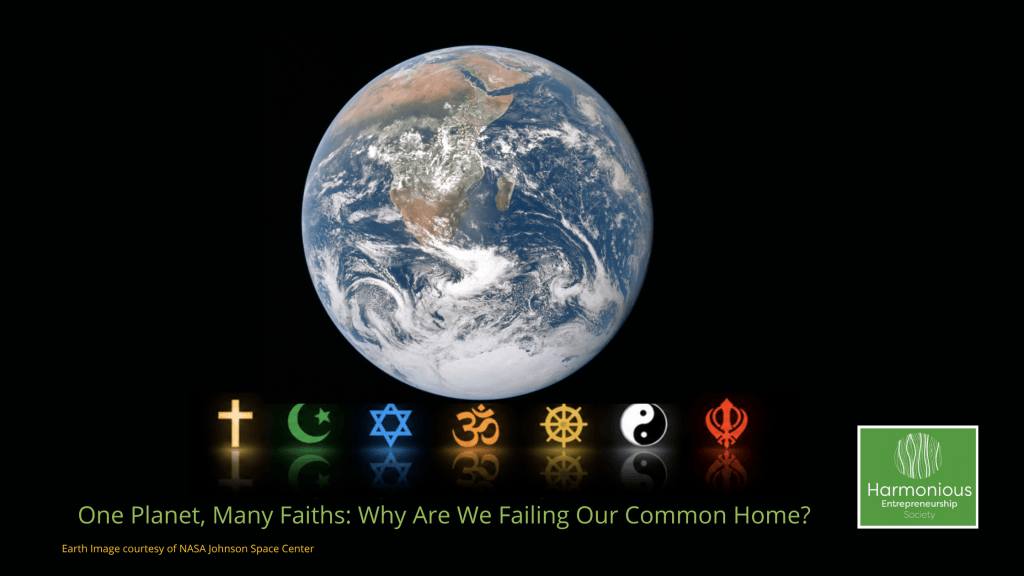
Image Banner: Earth as seen by the Apollo 17 crew, 7 December 1972. Image courtesy of NASA Johnson Space Center.
References
El-Bassiouny, N., Abdou, Y.A., El-Bassiouny, D., Jamal, A., and Wilson, J. (2022). Qur’anic Wisdom and the sustainability mindset: deciphering the relationship. Journal of Islamic Marketing. 4th February.
Friedman, M. (1970). The Social and Ethical Responsibility of Business is to increase its profits. New York Times. September 13. 122–126.
Isenberg, D. (2014). Entrepreneurship always leads to inequality. Harvard Business Review. March 10th.
Kirby, D.A. and Healey-Benson, F. (2024). Harmomious Entrepreneurship: a sustainable model for addressing global inequality. Journal of Entrepreneurship in Emerging Economies. 17(1), 26–44.


Thought-provoking and enlightening. Not being aware of the Catholic Church’s new publication, “Caring for our Common Home” could be a mantra for everyone to live by. At this time of year, as we celebrate our Harvest Festivals, some more abundant than others, we take for granted those who toil and produce and without whom life would be even more challenging. As society is becoming even more secular, it is sad that ancient religions and philosophies don’t play a greater role in how we live, breathe and work. Perhaps we are at a cross-roads and the next generation of entrepreneurs will be more aware of people, profit and planet. We live in hope.
LikeLike