

“I started Beauty Kitchen to use business as a force for good with an equal weighting on the community, the environment and profit in every decision we make” (Jo-Anne Chidley)
In 1995 Jo-Anne Chidley, the co-founder of Beauty Kitchen, graduated from the University of Strathclyde in Scotland with a BSc in Analytical Chemistry. However, she embarked on a career in HR, including 3 years with Avon cosmetics, and it was not until 2014 that she launched Beauty Kitchen UK Ltd in Glasgow with her husband, Stuart. The company sells effective, natural and sustainable skin care products and has sustainability and social equity at the heart of all that it does.

In 2017, after only 3 years of trading, Beauty Kitchen became a BCorp certified business with an impact score of 88.3, which rose to139.8 when it was recertified in 2020. The business, which only uses sustainably sourced natural ingredients, is also “Leaping Bunny” certified. This means that its products are not tested on animals and the business is cruelty free, including the way it treats its employees. It opposes modern slavery, is a living wage employer, does not differentiate between genders and requires its suppliers and contractors to comply with its values. Additionally, it is committed to a regenerative and inclusive future and through its partnership with “Earthly” it plants a mangrove tree on the island of Madagascar for every sale of over £10, thereby helping to support local communities and reduce poverty as well as CO2 from the atmosphere. Also, it contributes 2 per cent of its sales to charity and since 2019 has donated over £200,000 worth of products to some 869 charities involved in education, emergency relief, family welfare and youth care via “In Kind Direct” , a charity founded in 1996 by the then HRH The Prince of Wales (King Charles III).
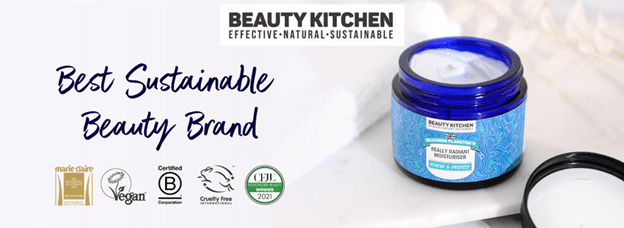
Inspired by the “cradle to cradle” concept, Jo and Beauty Kitchen have pioneered the circular economy in the beauty industry. Not only is their packaging recyclable and reusable but they have designed, developed and tested a consumer-friendly refill station that eliminates packaging waste, raises consumer awareness of the issue of sustainability and ensures reusable bottles are retained in use. In 2018, they launched Reposit, their returnable packaging platform and claim to have saved over 4 million single use plastic bottles from going to landfill.
Like the Harmonious Entrepreneurship Society, Jo wishes to introduce a new way of doing business. “Strategically Beauty Kitchen is set up not just to make profits”, says Jo, “but to look after the environment, the human element and to build both stakeholder and shareholder value. Right now, we believe we are the world’s most sustainable beauty company.” Beauty Kitchen is certainly an example of a successful holistic harmonious enterprise in which profit is not made at the expense of people and the planet. It is already operating in 8 countries and there is demand for it to expand territorially. It demonstrates that entrepreneurship and sustainability are not incompatible and while its main focus is SDG 12 (Responsible Production and Consumption) it does address SDGs 1 (No Poverty), 3 (Good Health and Wellbeing), 4 (Quality Education), 5 (Gender Equality), 8 (Decent Work and Economic Growth), 9 (Industry, Innovation and Infrastructure), 10 (Reduced Inequalities), 11 (Sustainable Cities and Communities), 13 (Climate Action), 15 (Life on Land) and 17 (Partnerships for the Goals.
© Harmonious-Entrepreneurship.org / Harmonious Entrepreneurship Ltd.
 HES 2020-2026
What a super case study of an ethical, profitable business – Beauty Kitchen – underpinned with the scientific expertise to develop, test and deliver products which meet a discerning market need. Much of their best practice could be cascaded to new, emerging businesses who want to adopt a new business model. Start as they mean to grow…..
LikeLike