

“Access to safe water is a human right which almost a third of the planet is being denied. But cleaning polluted waterways requires energy, and we must ensure that our efforts to heal the planet don’t inadvertently create new harm” (Dr Orianna Bretschger)
Orianna Bretschger, the co-founder of Aquacycl, has realised the importance of clean, fresh water supplies all of her life, having been brought up in the south of the USA, often in homes that had no running water or plumbing. After school, she continued her education at the University of Southern California, where she studied material science and engineering before, on graduation, undertaking research into how to control, electronically, how bacteria breathe and eat. Initially, she applied her findings to battery technology before realising that they could be applied to the treatment of waste. She knew that, though only 20 percent of waste water is treated, it results in the emission of more greenhouse gases than the entire shipping industry, and that the 80 per cent that is either untreated or only minimally treated has harmful effects on both the environment and human health. In particular, it impacts the life of women and young girls in developing economies who spend much of their time collecting clean, fresh water (see Gongali Model Company, Tanzania).
Accordingly, in 2016 she and Dr Sofia Babanova, both researchers in the electro-microbiology group of the pioneering J. Craig Venter Institute, launched Aquacycl in Escondido, California, in order to provide a cost effective on site waste water treatment system that makes the treatment of waste water more affordable, more efficient and less carbon intensive. It does so using the venture’s patented Bio-Electrochemical Treatment Technology (BETT). This uses bacteria to remove pollutants at a rate 10 times higher than conventional treatments and reduces the greenhouse gas emissions involved in water treatment by over 50 per cent. As the process generates electricity, it operates with low or net-zero energy requirements, thereby reducing operating costs. At the same time it also reduces the use of fossil fuels for road haulage since the cells used in the process are the size of a car battery, and can be stored and serviced on site in 20-foot shipping containers in which the reaction takes place. Overall, such savings cut the cost of waste water management by over 30 per cent on average.

To date the main clients of Aquacycl have been large food and beverage plants that produce substantial quantities of sludge and waste water that enter the sewerage system or landfill. In one pilot project with PepsiCo on its bottling plant at Fresno in California, not only were the agreed KPIs exceeded, but the system mitigated 100 tons of greenhouse gas emissions per month. However, the system can be scaled up or down, apart from targeting the big textile and paper producers Aquacycl’s mission is “sanitation for all,” their aim being to bring its off-sewer and off-grid solutions to over 100 million individuals by 2026. Its vision is a world where waste water treatment and sanitation are available to everyone anywhere in the world, regardless of available energy or sewerage grids. Their team is passionate about turning the vision into a reality and is highly principled, believing in transparent leadership, open communication, customer prioritisation, and diversity acceptance. They collaborate with equally passionate and principled individuals and organisations in order to ensure it happens, and in November 2023, they opened their first office and test centre at the Water Campus in Leeuwarden in the Netherlands. According to Reinder de Jong (the Dutch Foreign Direct Investment and Water Technology Project Manager) “The Water Campus is a great place for Aquacycl because it’s a well-developed ecosystem of research, facilities, and companies that can provide them with new opportunities for innovation and collaboration.”
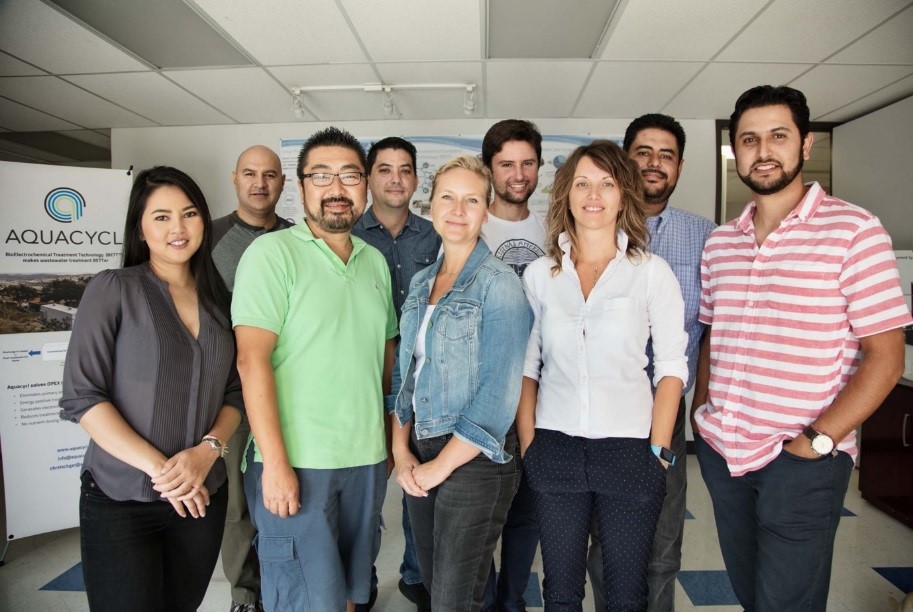
With a turnover of over $100 million, Aquacycl was a finalist in the Earthshot Prize for 2023 and is very much a Harmonious Enterprise. Profit, planet and people are in harmony and the venture addresses SDGs 6 (Clean Water and Sanitation), 13 (Climate Action), 3 (Good Health and Well-being), 7 (Affordable and Clean Energy), 9 (Industry, Innovation and infrastructure), 12 (Responsible Consumption and Production), 10 (Reduced Inequalities), 5 (Gender Inequality) and 17 (Partnerships for the Goals).
References
Anonymous (2023), Aquacycl is a finalist for The Earthshot Prize 2023. Waste Water and Sustainability. 22nd September.
Elkins, E., (2023), Aquacycl Pushing Wastewater into a Sustainable Future. California Star. April 11th.
© Harmonious-Entrepreneurship.org / Harmonious Entrepreneurship Ltd. (2020-2024).
 HES 2020-2026