
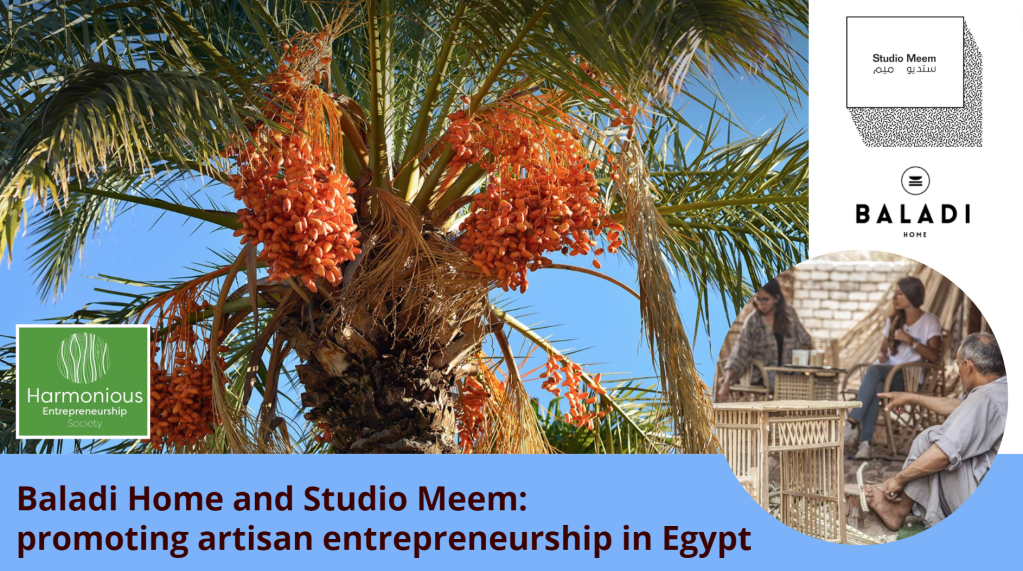
I’m always intrigued by how creative the people are. When I go home and try to come up with my own designs, I can’t come even close. – Manar Moursi
There are an estimated 20 million palm trees in Egypt. Not only do they provide much-needed shade for people and animals in the scorching desert heat, but each palm tree can absorb some 200 kilograms of CO2 a year, helping reduce our carbon footprint. Also, it has been found that date palms can be converted into biofuel thereby reducing our reliance on pollution-producing fossil fuels. So, palm trees are an important contributor to the fight against climate change and the preservation of both the planet and its people. However, they also contribute to wealth creation and the alleviation of poverty by providing farmers with an important revenue stream. A single date palm tree can yield a date crop of more than 100 kilograms. This enables Egypt to generate valuable export income from the 1.7 million tons of dates it produces each year, which account for 21 per cent of the global production. Not only that but for centuries they have been used not solely as a food crop but for a variety of purposes, including the ancient art of basket weaving.
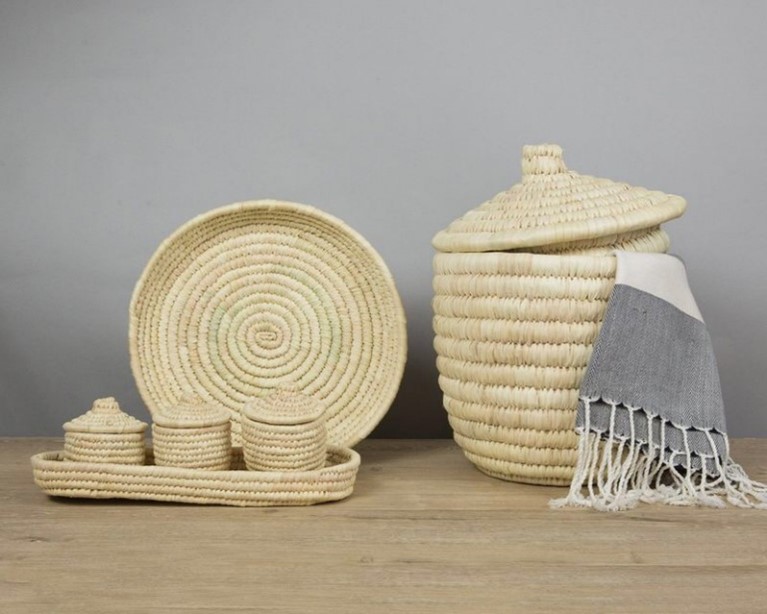
In 2018, Tinne Van Loon, a graduate of the College for Creative Studies in Detroit and the University of the Arts in London, created Baladi Home as an international marketplace for ethically made Egyptian artisan products [Baladi means of the country]. These included the products of the Palm Weavers of Fayoum, a co-operative of 174 women living in the Western Desert villages of the Fayoum oasis. Traditionally the women have made the palm leaf baskets used by retailers to display their fresh vegetables, fruits and spices. While they continue to produce such baskets for the local market they are now also producing high quality products for international export markets. Some are traditional designs handed down from generation to generation, others are modern designs created by Tinne and produced in small batches by the artisan palm weavers. They are then sent to Baladi’s warehouse in the USA but before they are the women are paid fairly and in full. The proceeds from the eventual sale of the products are then reinvested back into the artisan communities, which they support also with medical convoys, literacy classes and business workshops, as well as with help with product development and sourcing.
When explaining why she founded Baladi, Tinni observes that she and her husband “were inspired to give back to the country that gave so much to us”.
Another, similar project promoting artisan crafts using palm trees has been developed by Manar Moursi, an Architecture and Urban Policy graduate of Princeton University and founder of Studio Meem, which she launched in 2011. The aim of the studio is to generate creativity and to transform ordinary ideas into amazing ideas. To do so Manar works with local artisans to produce unique, sustainable products that celebrate Egypt’s cultural heritage.
One such project, “Off the Gireed”, is to turn traditional palm fibre crates into furniture. Traditionally the crates, which are used to stack fruit and vegetables, have been woven by men from palm midrib, which is harvested during the pruning of the palm trees. It is exceptionally sturdy and very flexible making it ideal for the production of the traditional sturdy, robust crates which, today, are being replaced by the ubiquitous, universal modern-day less healthy plastic crate. So according to Manar she “decided to experiment with these crates to make new furniture” in order to use the material to highlight its once common application. In 2011, therefore, she made a prototype series of products including bookshelves, coffee and side tables, a footstool and a lamp and was awarded both a Good Design Award and a Red Dot international design award. Initially she bought old crates from fruit and vegetable sellers and recycled them into furniture, but with the aid of a grant from the British Council she was able to have crates made for her, but first she had to find the producers. So, she began searching for them as she wanted a constant supply. When she found them in the village of Om Khenan, south of Cairo, the men obliged and she began working with them to develop and refine the designs, though it was not until they saw her finished products that they understood what she was doing and it became a team effort. As she says, “they were like ‘Oh, ok, so that’s what you’re doing’ – or that’s what we’re doing together. Because they’re a part of the process”. Since then, the project has developed and Manar has had proposals from universities in Europe wishing to partner with her and she is hoping that” the project will have a mushroom effect on young designers wanting to collaborate with other artisans to create new things to create some kind of economic viability”.

Together, Baladi and Studio Meem are addressing SDGs 1 ((No Poverty), 8 (Decent Work and Economic Growth), 9 (Industry, Innovation and Infrastructure), 10 (Reduced Inequalities), 11 (Sustainable Cities and Communities), 12 (Responsible Consumption and Production), 13 (Climate Action) and 15 (Life on Land). Additionally, Baladi is contributing, also, to SDG 3 (Good Health and Wellbeing) and 4 (Quality Education). They are both Harmonious Enterprises that seek profit, but not at the expense of people and planet.
© Harmonious-Entrepreneurship.org / Harmonious Entrepreneurship Ltd. (2020-2023). Excerpts and links may be used, provided that full and clear credit is given to Harmonious-Entrepreneurship.org/ Harmonious Entrepreneurship Ltd.

 HES 2020-2026