
As we show in our forthcoming Edward Elgar Book on the “History of Entrepreneurship Education in the UK, 1860-2020” (Pittaway, Henry, Kirby and Thompson, 2027), the re-creation of an enterprise culture in the UK is a relatively recent phenomenon. While it was initiated in 1970 with the publication of the Government’s Bolton Report on Small Firms, it was not fully introduced until the election of the Rt Honorable Margaret Thatcher as Prime Minister in 1979. Born to a small independent grocer in the town of Grantham, she was an advocate of free-trade capitalism and a follower of the American Nobel Prize – winning Economist, Milton Friedman, particularly his shareholder value theory. Speaking at a Conservative Party conference in 1975, prior to her becoming Prime Minister, she proclaimed “The way to recovery is through profits. Good profits today, leading to high investment, well paid jobs and a better standard of living tomorrow”. In theory she was right and in many parts of the world there has been an improvement in the standard of living. In reality, however poverty, homelessness and inequality remain, as does exploitation, while there has also been damage to both the man-made and natural environments, as well as to the physical infrastructure. As a consequence, the world is facing a Sustainability Challenge of crisis proportions.
The reason for this, we contend, is that the good profits envisaged by Thatcher have often not materialised. Ever since the publication of Friedman’s 1970 shareholder value doctrine, the focus of business has been on making “as much money as possible” to satisfy shareholders. Indeed, it has been a common misconception that it is a legal requirement for businesses to maximise profits. It is not but, in their drive for profitability, businesses have often not just failed to re-invest, as Thatcher expected, but have caused harm to both the planet and its inhabitants. Interestingly what Friedman actually said was that it is the responsibility of business to make as much money as possible within the basic rules of society, as embodied in both law and in ethical custom. While he did not explain what he meant by ethical custom, it is generally held that he believed that businesses should conform to the rules that protect people from harm, which would include harm both to their person and to the planet they rely on for their existence.
While this focus on profit has contributed to the present-day global sustainability problem and failed to fulfil Prime Minister Thatcher’s expectations and prophecy, there is also a further issue, namely the systemic nature of the challenge itself– the failure to appreciate that the planet is a system composed of at least three interconnected economic, environmental and social subsystems. In accordance with systems thinking, this means that changing the status of one subsystem impacts the other two, and, in accordance with the First Law of Cybernetics, any solution to the problem will have to be as complex as the problem itself. To address the sustainability challenge, therefore, it is necessary to address all three subsystems at the same time not separately, one at a time, as has been the case. It is for this reason that we have developed Harmonious Entrepreneurship, which addresses the sustainability challenge by creating businesses that have a triple bottom line in which profit, planet and people are in harmony with each other. Since introducing the concept in 2020, we have identified over 180 MSMEs, mainly startups, that exemplify it, at least 4 of which became either finalists or winners of the Earthshott Prize, introduced by HRH the Prince of Wales in 2022.
If we are to address the Sustainability Challenge and profits are to be the road to recovery, it will be necessary to change the way entrepreneurship is taught, together with the mindset of founders and business leaders. The focus on profit in the curriculum will need to be reduced, sustainability and systems thinking will need to be introduced and founders and business leaders must learn, as Henry Ford acknowledged, that “when anyone tries to run a business solely for profit then the business must die”.
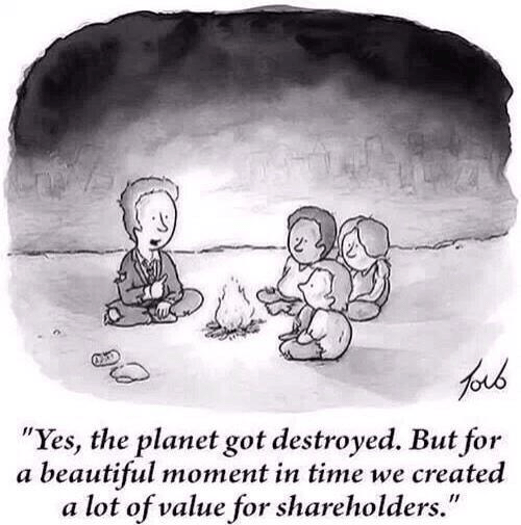
To misquote Mark 8:36. “For what shall it profit a man if he destroys the whole world and loses his soul”.
.


How times are changing – or are they? We can see from this week’s IT company Nvidia shareholding that trillions of dollars have been made or lost through an individual’s status and perceived value. When global markets can fluctuate impacting on everything else, we still see profit as the motivator. However, we must be positive. A new generation of businesses and agencies are being created with more conscience and sustainability – people, profit and planet being embedded in their ethos and practice. It will take time – the essay refers to Thatcher’s era which is almost 50 years ago, half a century. And, academia, investors, fund managers, governments can build the triple bottom line into procurement processes if there is a commitment to our future generations. Profit with a conscience is a necessity of we are to see economic recovery and growth in developed and developing countries.
LikeLike