
“In our everyday deliberations, we must consider the impact of our decisions on the next seven generations” (The Great Law of the Iroquois Confederacy).
Seventh Generation is an American Company that sells eco-friendly cleaning, paper and personal care products. It was founded in 1988 by Alan Newman, a 42-year-old serial entrepreneur and graduate of Long Island University. He had bought a small catalogue business, “Renew America”, that sold water and energy conservation products. In 1989 he partnered with Jeffrey Hollander, author of “How to make the World a Better Place”. They changed the name of the business and diversified its product range, selling not just the company’s environmentally friendly products but the idea of a more healthy, sustainable and equitable world for both the present and future generations.


Although they were ahead of the modern day “green” movement their products proved to be popular and demand for them was strong, the New York Times reporting that in one-year sales increased 7-fold. In their second year in business the company had a turnover of $1 million while the following year it had risen to $7 million. After that, however, sales plateaued and they had to cut salaries and eventually shed half of their staff, some 60 people.
In 1992 Newman left the company to found the Magic Hat Brewing Company and in 1993 Hollander, as CEO of Seventh Generation, decided that the company should go public. However, this raised only $7 million, and Seventh Generation still struggled financially and remained small. Eventually, in 1995, he sold the catalogue side of the business and focused solely on building the wholesale business with partner natural food stores, supermarkets, mass merchandisers and online retailers.
It took a further decade before the business became profitable but in 2009, after 10 years of double-digit growth, gross sales declined by2.8 per cent. Hollander stepped down as CEO but self-appointed his successor who lasted only a matter of months before resigning. In October 2010 the Board terminated Hollander’s employment and started the search for a new CEO. Between 2010 and 2016 the company was managed by a series of externally recruited CEOs before being a sold, in October 2016, to Unilever for a reported $700 million. Unilever bought Seventh Generation in order to meet the rising demand for “products with a purpose” and included in the sale was a clause that ensured Seventh Generation’s mission and purpose would be protected. So, while sales increased (to $200 million) and the company grew to 170 employees its mission and vision remained constant. Accordingly, the Seventh Generation still fights for: –
- Real zero emissions
- Zero Waste Packaging
- 100 per cent Sustainable Sourced Products
- Zero Chronic Toxins.
- The rights and tribal sovereignty of the indigenous communities from which their name was derived. To this end it directs 100 per cent of the funds of the Seventh Generation’s Foundation to indigenous led organisations.
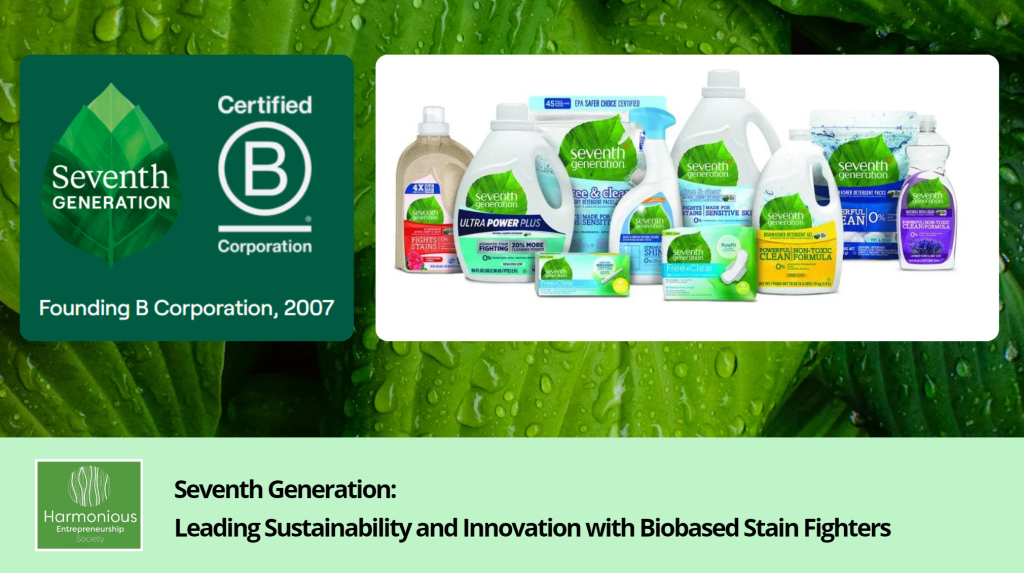
Over the years the company has received various awards. In 2007 it gained BCorp certification with an impact score of 114. 5 and in 2018 it was recognised as one of the 50 most sustainable companies in the world.

As the company’s CEO, Alison Whritenour, has observed “we believe that business can and should be a force for good. And we are on a mission to create a more healthy, sustainable and equitable world for generations to come”.
Seventh Generation is clearly a Harmonious Enterprise that measures its “success in positive impacts for people and planet – not just profit”. It addresses SDG 13 (Climate Action), as well as SDGs 3, (Good Health and Wellbeing), 8 (Decent Work and Economic Growth), 9 (Industry, Innovation and Infrastructure), 10 (Reduced Inequalities), 12 (Responsible Consumption and Production) and 17 (Partnerships for the Goals).
Reference
Lagorio-Chafkin, C (2019), How Seventh Generation Became a Powerhouse Brand- with help from Whole Foods toilet paper aisle. Inc. Newsletter. July 18.
© Harmonious-Entrepreneurship.org / Harmonious Entrepreneurship Ltd.
 HES 2020-2026