

“The project is developing a model of small scale agriculture, independent of subsidies, on marginal land and promoting natural cider and minimum intervention orcharding.” – Bill Bleasdale and Chava Richman
Although apples have been used to make alcoholic drinks in Britain since Roman times (AD 43 to 410), it was not until the 12th century that cider making was introduced, and not until the 14th century in Wales, mainly in Mid Wales and the South East of the country. However, it soon became the drink of the farm workers, which it remained until after the Second World War, when the industry collapsed, as it did in England and elsewhere. Unlike in England, though, where pockets remained, commercial cider production ceased completely in Wales, though the trees remained. In the 1980s, however, small craft cider makers began to emerge once more, using the apples from the old trees. These are different from those found in England, the world’s largest cider producer, and the sector grew quickly so that by 2010, there were an estimated 40 Welsh producers.
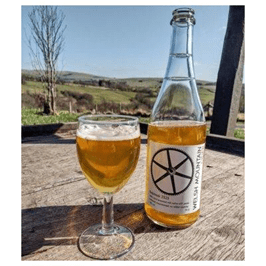
One such venture is the award winning Welsh Mountain Cider. It was once described by the BBC Wine Expert, Jack Wadsack, as “The best cider in Wales. Possibly the world”, while the TV chef, James Martin, observed that Welsh Mountain Cider was the best cider he had ever had.
Located some 1100 feet above sea level on a 6 acre site in the Cambrian Mountains near Llanidloes in Mid Wales, the farm has over 450 varieties of apple trees as well as pear trees. It is a family business run by Bill Bleasdale and Chava Richman. Bill is a fine art graduate who was working as a stained glass artist when, in 2005, he bought the land and started planting trees. There were no apple trees there originally, and it was believed that they should not be planted at an altitude of over 800 feet, but Bill and his friends planted 22 trees, each of a different variety. Chava, in contrast, is an Agroecology and Fine Art graduate of the University of California, Santa Cruz. She came to Britain from Sonoma County, California, to study farming and cider making. Here she met Bill, fell in love, and joined the Prospect Orchard project, which not only produces natural cider but is also a tree nursery grafting and growing hardy apple and pear trees.

All of their ciders are made from different blends of sweet, bittersweet, and sharp apples, with no additives. The apples are freshly pressed in the open air and then allowed to ferment slowly, being cellar-aged for up to two years before being bottled, unfiltered, and unpasteurised. As Bill says, “the moment you sterilise something, you start to kill it”. Not only does this process produce different tastes and types of cider, but also, like wine, different vintages. As the cider is live, each vintage is different, and each batch varies. “If there’s a hundred flavours in grapes, there’s a thousand in apples”, says Bill.
Apart from no additives, there is no spraying and no machine picking. At one time, sheep were used to trim the grass, but they ate the saplings, so now Bill and Chava have re-wilded and created a biodiverse meadow, trimming the grass manually. Additionally, their packaging is plastic-free and recyclable, so they are clearly dedicated to natural products and the natural movement. They are not a large producer of cider and have no intentions of becoming one. While quantities vary, they have never exceeded 7,000 litres. As well as selling direct and through their online shop, their cider is sold through a small number of retail outlets in mid Wales and “The Cat in the Glass” in Manchester, a small, independent retail start-up specialising in craft beer and artisan cider.
As well as cider making, Bill and Chava have the tree nursery, Prospect Orchard, which acts as a parent to apple orchards across the country. It is a time-consuming and demanding activity, but one that is highly rewarding, knowing they are responsible for the new orchards that are being developed. Also, they arrange cider tours not only to promote sales and their business but also to teach people about cider making. Indeed, Bill has written a 40 page booklet entitled “How to Grow Apples and Make Cider.”. It is based on his own practical experience and contains “all the information one needs to grow apples and pears and turn them into cider, perry, or juice”.
Despite the heavy rainfall experienced in Wales, Bill and Chava have experienced water shortages resulting from the thin soils not retaining moisture owing to the steepness of the slopes. Also, they have had to contend with a shortage of pollinators attracting flora, as well as bureaucracy. Having been told that pressing has to take place either in a certified food room or outside, they press their apples out of doors.

In spite of such difficulties, Bill and Chava have created a successful, quality Harmonious Enterprise that conforms to the Welsh Well-being of Future Generations Act through its contribution to the Clean Air Bill, the Pollination Action Plan for Wales, and the Wales Community Grown Food Action Plan. Additionally, it addresses SDGs 15 (Life on Land), 12 (Responsible Consumption and Production), 9 (Industry, Innovation, and Infrastructure), 4 (Quality Education), and 13 (Climate Change). While it is a for-profit business, profit, planet, and people are in harmony.
References
Wells, A (2021a), A vintage vertical of Welsh Mountain’s Prospect Orchard. Cider-review.com.18th July.
Wells, A. (2021b), A Visit to Welsh Mountain Cider. Cider-review.com. 28th August.
© Harmonious-Entrepreneurship.org / Harmonious Entrepreneurship Ltd. (2020-2024).
 HES 2020-2026