
“The business of business should not just be about money, it should be about responsibility. It should be about public good, not personal greed” (Dame Anita Roddick).
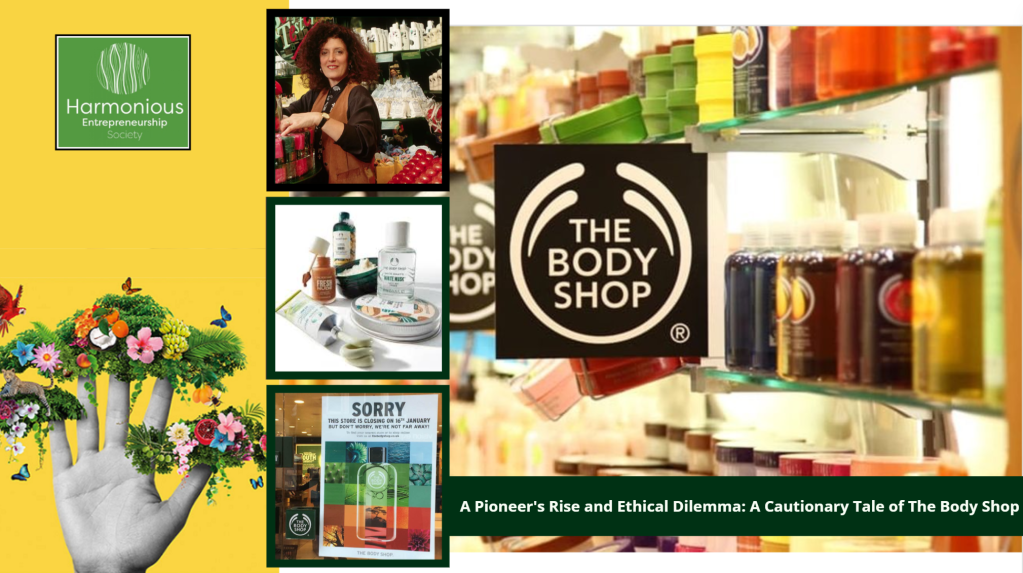
Possibly the first example of a modern harmonious retail enterprise, The Body Shop operated 3000 outlets in 70 countries in February 2024 when it announced it was appointing administrators to handle the insolvency process in its UK operation. The company was founded in Brighton in 1976 by 34-year-old Anita Roddick. A former teacher and human rights and environmental activist, Anita set up the venture without any prior experience in business, on a bank loan, and with the intention of earning money for her and her daughters while her husband was working abroad. The shop sold natural beauty and body care products that were sourced directly from the producers, were not tested on animals, and were packaged simply and inexpensively. The consumers liked the concept, and 6 months later she opened her second shop. When her husband returned home, he joined the business, and it grew rapidly, primarily through franchising. Within 15 years, it had opened 700 stores and, by the turn of the century, had 2000 outlets in 55 countries.
Anita was concerned that “nature is suffering at our hands” and “our society remains desperately, deeply unfair, and unequal”. Hence, the mission of The Body Shop was quite simple and clear, namely “to fight for a fairer, more beautiful world”. To do this, it had 5 core values
- Support Community Trade
- Defend Human Rights
- No testing on animals
- Activate self-esteem
- Protect our planet.
At the same time, the empowerment of women was at the core of the business, and it was these ethical values that gave it its unique selling proposition (USP). Given the company’s success, it was not long, though, before copycat competitor businesses emerged and the multiple retailers introduced their own sustainability brands. Possibly the most high profile of the copycats was the New Albany, Ohio, “Bath and Body Works”, which opened its first store in Cambridge, Massachusetts, in 1990. In 1991, The Body Shop sued the company and won its case, with the result that “Bath and Body Works” rebranded and, in 1997, introduced a secondary brand known as “Bath and Body Works at Home”. Even so, the market that Anita had created became increasingly populated and competitive.
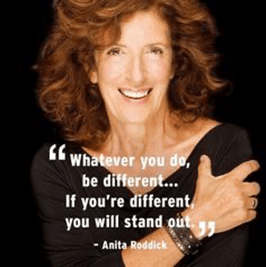
In 2003, Anita was made a Dame Commander of the Order of The British Empire in recognition of her achievements and contribution to sustainability, but in 2007, she sadly died, leaving her £51 million estate to the Roddick Foundation in order to fund campaigns on green issues, human rights, and third world debt. Commenting on her achievements, the Prime Minister, Rt. Hon. Gordon Brown, MP, described her as a true pioneer who will be remembered as a great entrepreneur.
Her legacy lived on, however. Together with her husband, Anita had set up a charity in 1989, The Body Shop Foundation. It was funded by The Body Shop, though separate from it. They intended it to be independent of the company and to “support those that the company could not”. By 2016, when the closure of the Foundation was announced, it had made grants totalling £24 million, mainly to environmental and animal causes. At its peak in 2004, it had an income of almost £2 million, whereas in December 2015, its income for the 10 months from February was only £450,000. In 2006, the Roddicks sold the business to L’Oréal (a world-leading French cosmetics brand) for £652.3 million, and since the sale, the Foundation’s income had been in decline. Accordingly, in 2016, the Trustees announced its closure as it was no longer as sustainable as the independent organisation the founders had envisaged.
Never a good fit, L’Oréal then sold The Body Shop the following year (in 2017) to the Brazilian cosmetics firm Natura, which, in turn, sold it in November 2023, six years later, to the global equity group Aurelius. After a Christmas and New Year trading period that was not as good as had been anticipated, Aurelius announced, in February 2024, that it was appointing administrators to handle the insolvency of its 200 stores in the U.K. According to Natasha Hatherall, the founder and CEO of TishTash, a marketing and communication agency, this was because The Body Shop had lost its way since its sale, having “struggled to hold onto its ethical and cruelty free credentials”. Meanwhile, Mark Constantine, the co-founder and CEO of rival retailer Lush, blamed The Body Shop’s demise on shifts in manufacturing and profit-making strategies that deviated from its core values. He is reported to have said, “They lost that feeling one got when buying a Body Shop product – that you were helping to change the world”.

The Body Shop had addressed SDGs 12 (Responsible Consumption and Production), 10 (Reduced Inequalities), 5 (Gender Inequality), 8 (Decent Work and Economic Development), 11 (Sustainable Cities and Communities), 13 (Climate Action), 15 (Life on Land) and 9 (Industry, Innovation, and Infrastructure). When, in 2019, Natura obtained BCorp status, it amended The Body Shop’s governing documents to reflect that it was a Triple Bottom Line business “balancing people, planet, and profit”. However, it would appear that profit, planet, and people were not in harmony with each other as they had been prior to the sale in 2006 – and that it was this that contributed to the company’s demise. Insolvency occurred not because of the company’s commitment to the planet and its inhabitants (“go woke, go broke”) but because The Body Shop had lost its USP by not being perceived to be committed to them, at a time when its prices and the competition had been increasing.
References
Hardcastle, K., (2024), The Body Shop Owners To Call In Administrators: what now for Beloved Beauty Brand? Forbes. February 10th
Jordan, D. (2024), The Body Shop to appoint administrators in the UK. BBCNews. 11th February.
© Harmonious-Entrepreneurship.org / Harmonious Entrepreneurship Ltd. (2020-2024).
“
 HES 2020-2026
Anita Roddick was decades before her time and had the courage and drive to succeed which has been covered comprehensively in this essay and, no doubt, had she survived she would have ensured that Body Shop maintained it’s role ahead of competitors. Although administrators have been appointed, who is to say that Body Shop cannot be re-imagined and build on their ethical and responsible business practices to meet the needs and expectation of a new generation.
LikeLike