
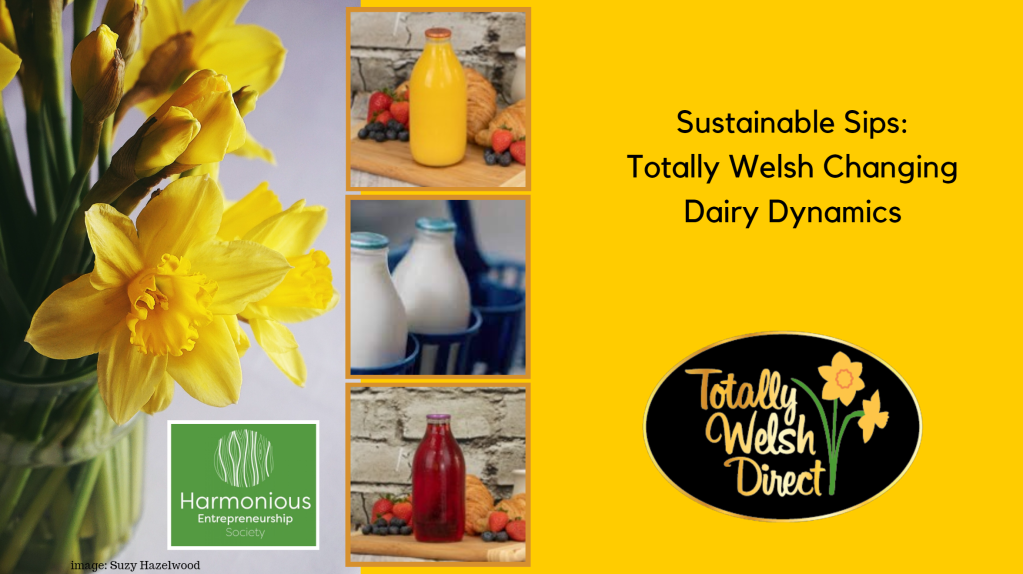
“Totally Welsh has always been about more than just dairy for us. The Brand embodies the Welsh community spirit.” (John Horsman, General Manager Totally Welsh)
Towards the end of the 19th century, milk began to be sold in bottles in both the UK and the USA. This enabled milk delivery roundsmen to supply fresh milk directly to homes, and customers were able to see the condition of their milk through the clear glass Towards the end of the 20th century, this practice tended to “die out” as paper cartons and plastic containers replaced glass bottles and milk began to be sold in grocery stores.
Against the trend, however, 24-year-old Mark Hunter opened a bottling plant in 1990 in Haverfordwest, the County Town of Pembrokeshire, in rural West Wales. His idea was to supply “Welsh milk, from Welsh cows, bottled in Wales.” Accordingly, all of the plant’s milk was and is produced within a forty-mile radius of Haverfordwest, the idea being to supply milk that is fresher for the consumer and better for the environment as the number of food miles travelled is reduced.
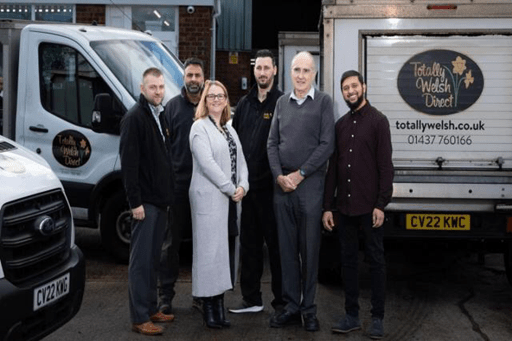
Over the years, Totally Welsh has grown, and following a £1 million investment in a state-of-the-art bottling line, it now produces 80–100,000 bottles of milk a week. It supplies fresh milk in traditional glass bottles each day to some 8000 homes in the urban centres of Cardiff and Swansea. Totally Welsh is committed to sustainability not only through their iconic reusable glass bottles but also by offering products in 100% recyclable High-density polyethylene (HDPE) containers. These HDPE bottles provide an environmentally responsible alternative to single-use plastics, aligning with the company’s eco-friendly ethos. While the glass bottles can be recycled (e.g., see Oseng-Rees Reflection), the HDPE bottles complement this approach by offering a recyclable option, reducing the environmental impact. This dual approach underscores Totally Welsh’s dedication to innovative and sustainable practices in dairy packaging. Additionally, the company has fitted solar panels to their factory roof as a backup to their main power supply and is in the process of shifting its delivery fleet to electric vehicles. As a result, whereas the average carbon footprint in the dairy industry is 1200g of CO2 per litre produced, for Totally Welsh it is only 186, and the company has pledged to reach net zero by 2050.
As well as increasing its doorstep milk delivery, Totally Welsh supplies hospitals, independent retailers, schools, and supermarkets and delivers three times a week into England. Additionally, it has added new food lines, also sourced from local farms. These can be ordered online and delivered with the milk. As one Cardiff customer observed, “We don’t just order milk from them; we order vegetables, Welsh cakes, garden products, and even cleaning products. I will only use their butter.” Accordingly, by 2022, it was operating out of three sites, had a turnover of £17 million, employed 110 people, and had plans for a new distribution hub in Cardiff to meet the increase in customer demand. As the General Manager, John Horsman acknowledged, “This expansion aligns perfectly with our long-standing commitment to sustainability. We’re not just bringing jobs to Cardiff; we’re bringing a vision for a greener, more sustainable future”.
When asked what advice and guidance he would give other businesses starting out John acknowledged the importance of caring for the firm’s people. His number one piece of advice was “Recruit well and ensure your staff are kept enthused and a part of your project through continuous assessment and appraising”. Additionally Totally Welsh cares for its customers and on Saint David’s Day1, 1st March, each customer received a free daffodil2 along with their doorstep milk order.
Totally Welsh is a profit making enterprise that addresses the sustainability challenge by caring for both the planet and its people, their customers, employees and suppliers. Profit, planet and people are in harmony and the business addresses SDGs 8 (Decent Work and Economic Growth), 11 (Sustainable Cities and Communities), 12 (Responsible Consumption and Production), 13 (Climate Action) and 15 (Life on Land).
Notes
- Saint David is the patron Saint of Wales
- The daffodil is the national flower of Wales
References
Anonymous (2020), Dairy Supplier Totally Welsh on expansion and success during the Covid-19 Crisis. Business Wales. 28th August.
Anonymous (2023). Totally Welsh brings the cream of the crop to Cardiff; New expansion promises fresh opportunities and jobs. Business Matters.16th November.
© Harmonious-Entrepreneurship.org / Harmonious Entrepreneurship Ltd. (2020-2023).
 HES 2020-2026