

Global Entrepreneurship Week 2018 was a good year for Felicity and I. We launched the Harmonious Entrepreneurship Society (https:// harmonious-entrerpreneurship.org/) not only to promote what became an award-winning concept but to address the global sustainability challenge, something entrepreneurship had contributed to and was significantly failing to resolve. Since then, we have published 7 academic papers and 6 book chapters, produced 14 conference presentations and reports, developed an educational MOOC and an online student competition and seen Harmonious Entrepreneurship formally recognised through its inclusion in the International Encyclopaedia of Business and Management. We have also researched and published some 150 vignettes of enterprises that are not just demonstrating the concept but are actually ensuring profit, planet and people remain in harmony.
Given the nature of the sustainability challenge any solution to it must be as complex as the problem it is attempting to resolve, in accordance with Asby’s Law of Requisite Variety (1969). The concept is therefore grounded in systems theory (von Bertalanffy, 1968) and, accordingly, does not just focus on one aspect of the problem. Rather it addresses all three – the physical environment, the economy and society. It also rejects Friedman’s (1970) doctrine that the purpose of business is to ‘make as much money as possible’ together with the contention of Isenberg (2014) that inequality is a consequence of entrepreneurship.
Often it is claimed that profit maximisation is a legal requirement of business. It is not, and our vignettes demonstrate what can be achieved. During Global Entrepreneurship Week 2025 we celebrate these ventures and their pioneering endeavours. They are not merely discussing the challenge or theorising about it but taking action, which is what entrepreneurs are supposed to do. They demonstrate that entrepreneurship can be a force for good and that wealth creation does not require the exploitation of the planet or people.
Recently in the UK, two high-profile cases of what Baumol (1990) called “destructive” entrepreneurship have drawn attention to what happens when the pursuit of wealth becomes detached from responsibility. While it is unclear what has motivated these entrepreneurs to act as they have, we contend that it is the single-minded focus on profit maximisation and the creation of wealth. This makes it necessary to rethink how entrepreneurship is taught and how nascent entrepreneurs are supported. We therefore welcome the steps being taken by entrepreneurship educators around the world to ensure that entrepreneurship is a force for good that can save not only the planet but its inhabitants by creating a more caring, sharing society grounded in the “economics of love”.

This year GEW’s theme, ‘Together We Build’, captures the spirit of what Harmonious Entrepreneurship is about. It recognises that real progress comes through collaboration and shared purpose. Felicity’s recent primary and secondary schools’ outreach through Harmonious Heroes in Llanelli reflects this same principle, it demonstrates how young people, teachers, and communities can build ideas together that create value for others and encourage more sustainable ways of thinking.

May this Global Entrepreneurship Week not just see the introduction of an innovative concept intended to save the planet or ongoing discussions about what needs to happen, but practical efforts. As the late Queen Elizabeth II reminded the world at COP 26 in 2021, it is time to move from words to action while we have “the chance to join in the shared objective of creating a safer and stabler future for our people and for the planet on which we depend”. Let us work together to make this happen.
David & Felicity
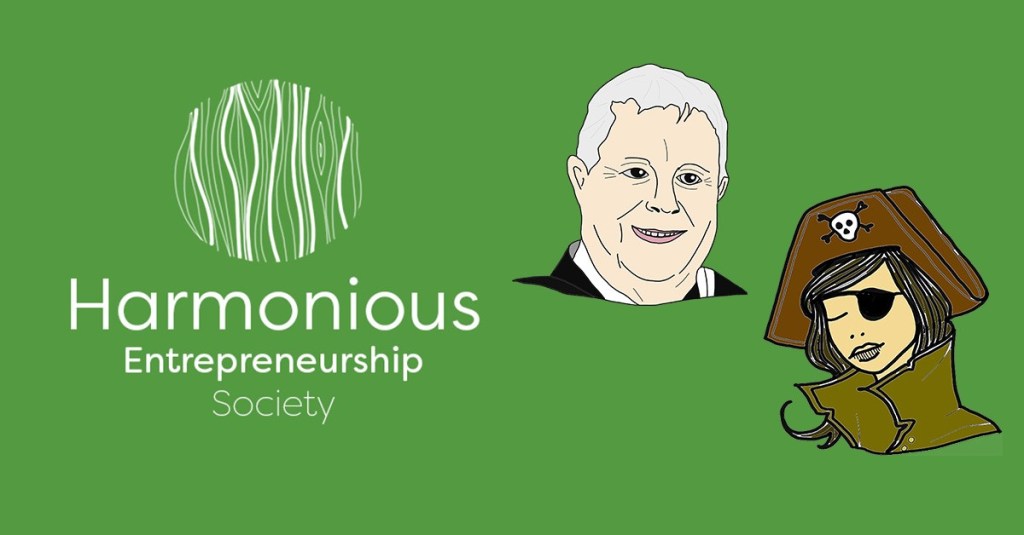
The Professor & the Pirate (C) HES, by Vanessa Damianou
#Entrepreneurship #Sustainability #Harmony #ICSB #ECSB #iSBE #EEUK #HEInnovate #UN #UNESCO #OECD
 HES 2020-2026
This short history of Harmonious Entrepreneurship Society clearly illustrates that it takes dedicated founders to seek out and celebrate those businesses/organisations/individuals who have approached their ventures with a new enthusiasm to “…do things differently.” The range of case studies has been interesting and provides an insight for new and existing businesses to review their practices, future-proof and build sustainability whilst still generating sufficient profits to survive. The emergence in recent years of the academic interest in embedding enterprise education across disciplines is a a major breakthrough and bodes well for equipping students and staff with skills to combat the changing world of work and career choices. Wishing HES another 7 years of growth and recognition.
LikeLike