

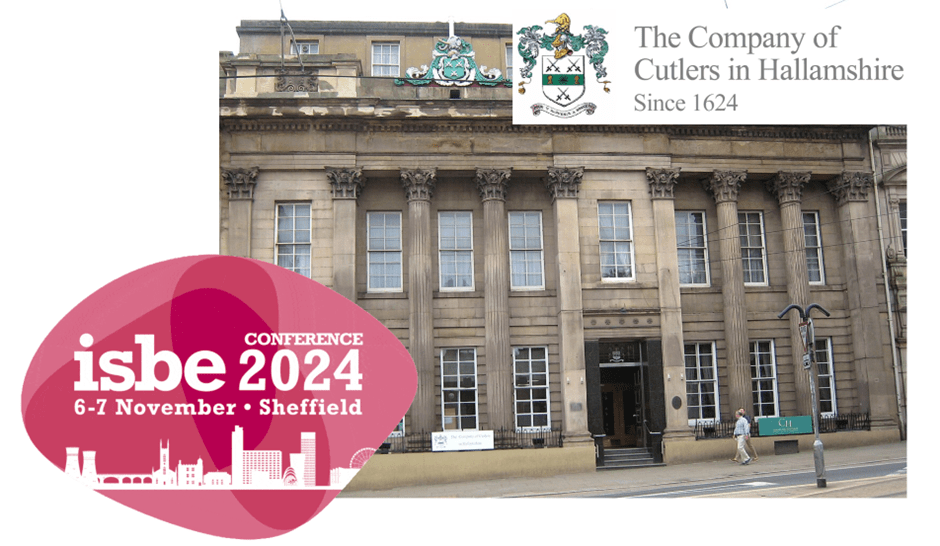
The magnificent Cutlers’ Hall in Sheffield provided a deeply symbolic backdrop for sharing our Harmonious Entrepreneurship research. This grand Victorian building, home to the Company of Cutlers since 1832, tells its own story of business evolution and social and environmental transformation. Once the heart of Sheffield’s prosperous cutlery and steel trade during an era when industrial growth often came at the cost of social equality, the Hall has witnessed the city’s journey from manufacturing powerhouse to a centre of innovation and social progress. There was profound resonance, therefore, in these historic rooms with our research presentation about Welsh harmonious enterprises. Where Sheffield’s cutlery trade once exemplified the stark inequalities of entrepreneurial industrialisation, our discussion now focused on how entrepreneurship might forge a more equitable future.
Our findings, which challenge the traditional assumptions about business success requiring social and environmental compromise, seemed particularly poignant in a venue that has witnessed both the triumphs and human costs of industrial enterprise. These findings, shared in the Drawing Room where generations of industrialists once gathered, highlighted how modern Welsh enterprises are demonstrating that commercial viability and social responsibility aren’t competing priorities but complementary forces.
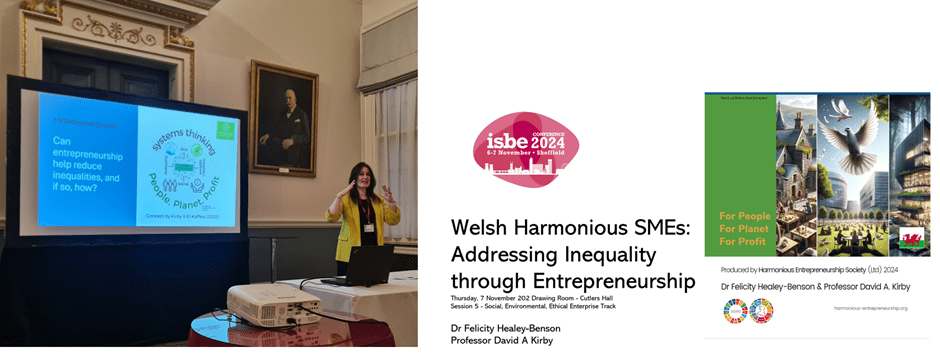
At the 46th annual ISBE conference in Sheffield, where the focus was squarely on creating “a more equitable world,” our examination of Welsh harmonious enterprises offered timely insights this an era where the wealthiest 1% capture nearly two-thirds of new wealth.
Through the lens of Harmonious Entrepreneurship, I presented a selection of exemplar Welsh SME cases that specifically address UN Sustainable Development Goals 10 (Reduced Inequalities) and 16 (Peace, Justice and Strong Institutions). These present a compelling counter-narrative to Isenberg’s (2014) assertion that “successful entrepreneurship always exacerbates local inequality”. Far from the traditional model of profit maximisation at any cost, these businesses have woven social and environmental responsibility into the very fabric of their operations. They’re not just creating jobs; they’re fostering genuine positive change for and through their localities and networks. Through innovative business models that balance profit with social progress, these enterprises demonstrate that commercial success need not come at the cost of social equity – indeed, their approach suggests that addressing inequality can itself be a driver of sustainable business growth.
Enthusiastic reception for the research reinforces what we’ve long suspected: there’s an appetite for change in how entrepreneurship is perceived taught and implemented.
Healey-Benson, F., & Kirby, D.A. (2024). Welsh Blueprint for Tackling Systemic inequality through Harmonious Entrepreneurship, Paper presented at 46th ISBE Annual Conference, Cutler’s Hall, Sheffield, 6-7 November 2024. Presented in the Social, Environmental, Ethical Enterprise Track.
Linked Blogs
 HES 2020-2026