

“Our ambition is to create a world where the value of a company is measured by the good that it does, as much as the profit it makes”. (Will and Nick, Co-founders of Ocean Bottle).
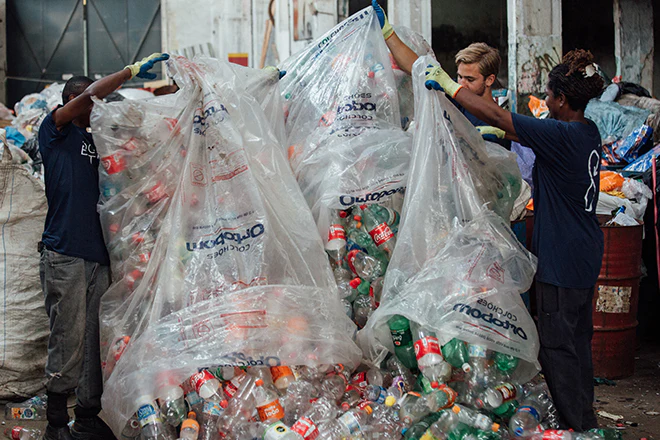
Ocean Bottle is a business with a purpose. While it markets its product as “the reusable water bottle that actually makes a difference” its bottles, in fact, are vacuum flasks that keep drinks warm or cool. The flasks are made from recycled steel and ocean-bound plastic, and for each one sold 1000 plastic bottles are collected by the residents of coastal communities in Brazil, Egypt, Ghana, India, Indonesia, Kenya and the Philippines. The collectors sell their plastic to a partner of Ocean Bottle, Plastic Bank (Plasticbank.com), boosting their income by as much as 60 per cent.
The business was founded in 2019 by two Masters in Management (MIM) graduates of London Business School, Will Pearson and Nick Doman. They met on the 2018 MIM programme and while Nick had graduated in 2017 with a Masters degree in History from Edinburgh University Will had a Mechanical Engineering and Management BEng degree of the University of Exeter. After obtaining his degree in 2016 he spent 9 months as a deck hand on a luxury yacht sailing from Malta to the Maldives. Although he had been sailing since he was a child, and knew about ocean plastic, he was horrified by what he saw. Apart from the plastic floating in the sea “the people on the boat brought over 1000 plastic bottles for drinking water” he says. When empty they took them to an island and burned them. So, when he met up with Nick, who was “looking to redefine business and prove we could fix environmental and societal issues by putting planet and people first”, they decided to do something about it and Ocean Bottle was founded.

Since 2019, the business has collected 13,649,357 kg of ocean-bound plastic and prevented over 1 billion plastic bottles from reaching the ocean. Ocean Bottle collaborates with 3 global Collection Partners thereby providing employment for the collectors in areas where plastic pollution is worst, and helping them to increase their income and “afford things like maternal care, or giving their kids a proper education”, says Will. He puts their achievements down to the team they have created. As he acknowledges “We can’t believe the team we’ve got, where we’ve got to and the impact we’ve created”. However, although Nick observes that pushing the planet first business model “wasn’t how they taught us to do it in business school”, he and Will both also acknowledge the support of London Business School and particularly its Launchpad programme. They spent 3 months on the programme developing the concept, the Ocean Bottle brand and their marketing strategy and they also learned how to pitch for funding and how to build a team. In 2021 they won the School’s “Accomplished Entrepreneur Award” which recognises alumni that have created successful entrepreneurial value.
Unsurprisingly they obtained B-Corp status in 2020 with an initial score of 89.6, and in 2024 this was increased to 107.6. As a business that measures itself by the good that it does not just the profit that it makes, therefore, Ocean Bottle is a Harmonious Enterprise in which profit, planet and people are in harmony with each other. It addresses SDGs 8 (Decent Work and Economic Growth), 9 (industry Innovation and Infrastructure), 10 (Reduced Inequalities), 11 (Sustainable Cities and Communities), 12 (Responsible Consumption and Production), 13 (Climate Action), 14 (Life Below Water) and 17 (Partnerships for the Goals).
References
Broomfield, E., (2022), Ocean Bottle: a planet-positive success story. London Business School, 25 January.
Early, C., (2020), The man with the bottle to take on the ocean plastic problem. Imagin5.com
© Harmonious-Entrepreneurship.org / Harmonious Entrepreneurship Ltd.
 HES 2020-2026